For Latin American exporters of iron, steel, aluminum, or fertilizers, success in the European market from 2026 onwards will partly depend on a key strategic decision: how to report the carbon footprint of their products.
The CBAM Regulation establishes two methodologies, but their cost implications differ significantly.
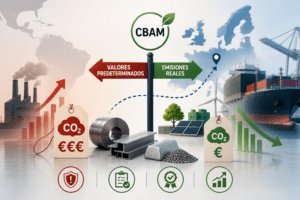
1. Default Values: the seemingly simple but potentially costly route
The European Commission publishes reference values based on the average emissions intensity per exporting country. At first glance, they appear to be a practical solution, but they carry important risks:
- Built-in safety margin: To ensure environmental integrity, these values include a markup on the average, meaning companies effectively pay for more emissions than they actually generate.
- Penalty for lack of data: If reliable data is not available for a country, the average of the 10 highest-emission countries for that product is applied. For an efficient company in Latin America, this can result in paying for CBAM certificates well above its actual emissions.
2. Actual Emissions: the value of transparency and competitiveness
Companies can calculate their emissions using primary data from their own production processes. The advantages are clear:
- Direct competitive advantage: If a plant in Peru, Brazil, or Chile operates more efficiently than the global average, reporting actual emissions directly reduces the number of CBAM certificates the European importer must surrender—and therefore the final cost of the product.
- Mandatory verification: Unlike default values, actual emissions must be verified by an accredited body to be accepted in the annual CBAM declaration. This requires preparing documentation and processes in advance.
What strategy is recommended for Latin America?
Several countries in the region have cleaner energy matrices than the global average or have made significant investments in industrial modernization. In this context, reporting actual emissions is emerging as a real competitive differentiation tool—not just a compliance exercise.
However, leveraging this advantage requires implementing a robust monitoring plan, aligned with EU methodology and ready for audit.